No reviews match your search. Try a different keyword.

Your Local Mortgage Advisor
Located in Annapolis, Maryland
Personalized Mortgage Experience
Jodi Hillmar offers personalized service and loan options you'll love. We shop multiple lenders to find the best rate and product for you, getting you into your dream home faster.
With wholesale interest rates and cutting-edge technology, we make the mortgage process seamless. Trust the experts who focus solely on mortgages. Support your local community and experience elite client service.
Let us help you achieve your homeownership dreams!
The Home Loan Process
Mortgage Pre-Approval
Get pre-approved from one of our Loan Officers to see how much you can afford.
House Shopping
Work with a trusted Real Estate Agent to find a home you would like to move into.
Loan Application
Complete your home loan application to get the lending process started.
Don't take my word for it
Verified client reviews
What clients say about working with Jodi Hillmar
Mortgage Advisor at Bay Capital Mortgage Corp., Annapolis, MD. Your loan officer, for life.
4.89
389 verified reviews
Experience.com 4.89 (324)
Zillow 4.9 (63)
Google 5.0 (1)
Facebook 5.0 (1)
Mortgage Programs
Experience the best mortgage experience located in Annapolis, Maryland .
Home Loan Options
Our experienced mortgage advisors will walk you through the best mortgage loan program that will fit your specific scenario.
Conventional Home Loans.
FHA Home Loans.
USDA Home Loans.
VA Home Loans.
Doctor's Loans.
Investor Loans (DSCR).
Cashflow Loans/ Bank Statement Loan.
100% financing with NO MI.
Frequently Asked Questions
How often can I refinance my mortgage?
There is no limit to the number of times you can refinance. However, you must qualify every time you apply and there will be costs associated with closing the loan each time.
Can I buy a home if I do not have money for a down payment?
Yes! There are a number of bond programs that offer low or no down payment financing options.
How do I know which mortgage is right for me?
The key to choosing the right mortgage is to understand the range of options and features available to you, as well as your budget, circumstances, and goals. Our licensed mortgage professionals are here to help you navigate that process. The more you know, the more comfortable and confident you will be choosing the best option for you and your family.
How long will the loan process take?
The Truth in Lending Act (TILA) does not permit a lender to close a loan until at least seven (7) business days have passed from the date your application was received. A typical home loan takes 30 days, as a number of third-party services such as appraisals, title work, and credit are required in conjunction with the mortgage process. Once you familiarize your Loan Officer with the details of your specific loan scenario, they will be able to provide you with a more specific timeline.
Will I qualify for a home loan?
The only way to find out is to speak with a qualified mortgage professional. Our Loan Officers have helped numerous clients who didn’t know if they could qualify to become home owners. We take the time to understand your financial situation and long-term financial goals, and then match you with the loan program that best fits your needs. Your approval for a loan may also largely depend on the price of the home you are financing. Getting pre-qualified prior to beginning your home search can give you an idea of what you may be able to afford.
Why do people refinance their mortgages?
Homeowners typically refinance to save money, either by obtaining a lower interest rate or by reducing the term of their loan. Refinancing is also a way to convert an adjustable loan to a fixed loan or to consolidate debts.
How much money will I have to pay upfront to buy a home?
This question does not have a simple, one-size-fits-all answer. The exact amount will depend on the price of the home you buy as well the type of mortgage financing you choose. Depending on your loan program, your down payment could be as much as 20% of the home’s price or as little as 3%, while some loans require no down payment at all.
Can I get a mortgage after bankruptcy?
You may still qualify for a home loan even if you have experienced a bankruptcy. The best way to find out if you qualify is to talk with a Loan Officer to discuss your options. Be sure to bring all paperwork regarding your bankruptcy so your Loan Officer can find the program that best fits your situation.
Should I lock my interest rate now, or wait until we are closer to our closing?
Interest rates fluctuate all day, every day. If an interest rate is good, it may be in your best interest to lock now. If you wait, you run the risk of an increase in rates later. If you are concerned that rates may go down after you lock, contact your Loan Officer to discuss your options. Some programs allow you to lock for an extended period and choose to lower your rate should a better one become available.
Most Recent Blog Updates
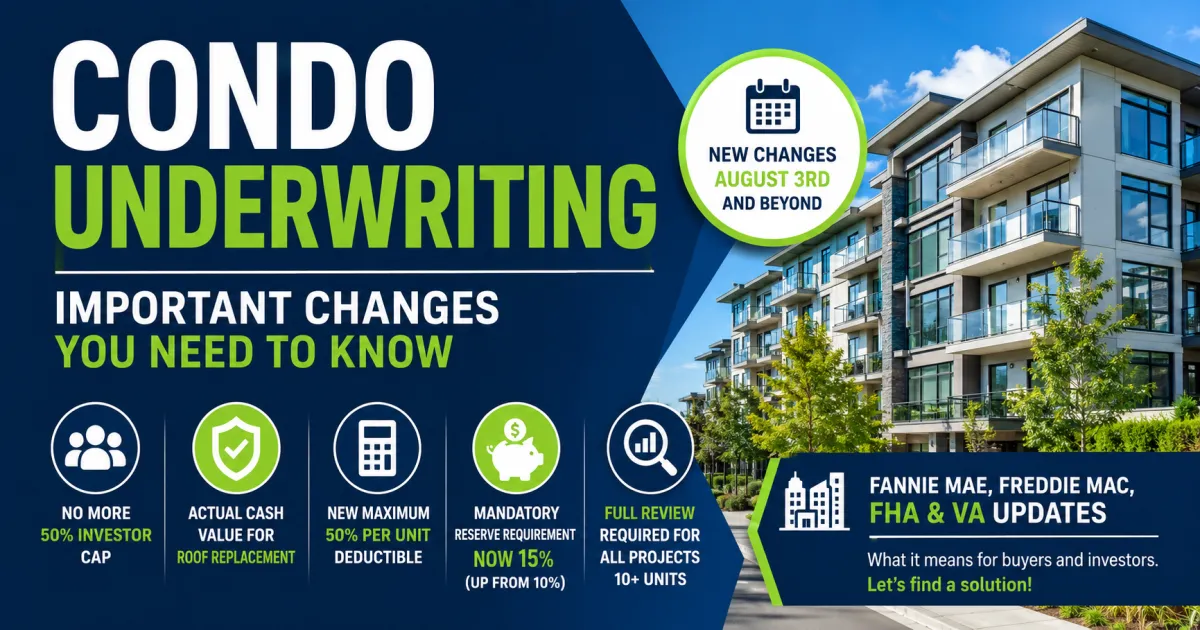
Major Condo Financing Rule Changes Are Here in August and Every Buyer and Agent Needs to Know Them
The Condo Underwriting Changes That Are Reshaping What Is Possible and What Is Not
Jodi Hillmar has an important update for anyone involved in a condo transaction right now. Earlier this year several changes hit the books and starting August 3rd more are in effect. Some of these changes open doors that were previously closed. Others add requirements that will slow down or complicate deals that might have sailed through before. Understanding both sides of what changed is essential for buyers, agents, and anyone working through a condo purchase right now.
What Changed on the Conventional Side With Fannie Mae and Freddie Mac
The fifty percent investor cap on condo projects has been eliminated. This is genuinely good news. Some developments that previously could not qualify for conventional financing because too many units were investor-owned may now be eligible. However eligibility is not automatic. The project still has to pass a full review and may still get stuck on other requirements. The removed cap opens a door but getting through it still requires clearing everything else.
On the insurance side the requirement for replacement cost coverage on roofs has been updated. Actual cash value coverage for roof replacement is now acceptable. Previously lenders required a policy that covered inflation on the replacement cost which drove insurance expenses higher. The shift to actual cash value coverage is designed to help reduce insurance costs for condo associations and the buyers who finance units within them.
A new maximum fifty percent per unit deductible replaces a more complicated calculation that was used previously. The simplification makes it easier to evaluate whether a project meets the insurance requirement without working through a complex formula.
The reserve requirement is increasing from ten percent to fifteen percent of the annual budget effective January 4th 2027. Many condos and investors are making this change now rather than waiting. The good news is that projects with adequate reserves already set aside may qualify to maintain the ten percent threshold. The reserve study is the mechanism that determines that. Every three years condos are required to commission an in-depth study of future repairs, maintenance needs, projected costs, and how much must be kept in savings to cover them. That study is the document that tells the lender whether the project's financial health supports the ten percent exception or requires the full fifteen.
The Elimination of the Limited and Streamlined Review
This is the change that will have the most immediate impact on transactions. The limited review and streamlined review were fast-track processes that allowed buyers putting more than ten percent down to skip the deep dive into HOA finances. That option is gone effective August 3rd for any project with ten units or more.
Every condo deal now goes through a full review regardless of down payment size. Underwriters are checking reserve funds, insurance coverage, litigation history, and everything else on every single deal. There is no shortcut based on how much the buyer is putting down.
A streamlined waiver remains available for projects with ten units or fewer. For anything above that threshold the full review is mandatory.
What This Means Practically
The deeper dive into HOA finances is going to surface issues on projects that previously cleared the limited review without scrutiny. Underfunded reserves, inadequate insurance, pending litigation, and other HOA problems that were not examined under the old fast-track process will now come up during underwriting on every conventional condo deal.
Starting the process early and getting the project reviewed before the appraisal is ordered is more important than ever because discovering a project problem late in the transaction creates delays or kills deals that could have been anticipated with earlier due diligence.
FHA and VA Condo Financing
FHA and VA both maintain master approved condo lists. FHA approvals come with expiration dates. If a development is not on the approved list there is a single unit approval option commonly called a spot approval that can open the door for an individual unit without requiring full project approval.
The building still has to meet requirements including strong reserves, no major litigation, and fifty percent or more owner occupancy. But a spot approval means that a unit in a non-approved complex is not automatically a no. It requires more work and the appraisal cannot be ordered until the project is cleared so starting early is critical. But the path exists and it is worth exploring before turning away a buyer who wants to purchase in a non-approved development.
Before You Say No on a Condo Deal
Jodi Hillmar's message to agents and buyers navigating this landscape is direct. Before you walk away from a condo deal because of financing concerns call and talk through the possibilities. The rules have changed in ways that close some doors and open others and knowing which category a specific project falls into requires someone who understands where the new lines are drawn.
Call Jodi Hillmar to work through the details on any condo deal and find a path forward for your buyer.
Sources
FannieMae.com
FreddieMac.com
HUD.gov
VA.gov
MortgageNewsDaily.com

Mortgage Calculator
See your total mortgage payments using the tool below.
16.67
%
%
years
$/year
%
$/year
$1,685.20
Your estimated monthly payment with PMI.
PMI:
$208.33
Monthly Tax Paid:
$200.00
Monthly Home Insurance:
$83.33
PMI End Date:
Dec 2027
Total PMI Payments:
27
Monthly Payment after PMI:
$1,476.87
🏠Mortgage Details
Loan Amount:
$250,000.00
Down Payment:
$50,000.00 (16.67%)
Total Interest Paid:
$179,673.77
Total PMI to :
$5,416.67
Total Tax Paid:
$72,000.00
Total Home Insurance:
$30,000.00
Total of 360 Payments:
$537,298.77
Loan pay-off date:
Sep 2055
⚖️Monthly Vs Bi-Weekly Payment
$1,476.87
Monthly Payment
Sep 2055
Pay-off Date
$179,673.77
Total Interest Paid
$738.44
Bi-weekly Payment
Aug 2051
Pay-off Date
$151,482.12
Total Interest Paid
Total Interest Savings: $28,191.64
Yearly Amortization Schedule
| Year | Interest | Principal | Balance |
|---|
SCHEDULE A CALL

Contact Us
(443) 306-3610
2553 Housley Rd Suite 200 Annapolis, MD 21401
Monday - Friday 10 AM–6 PM
Saturday 10 AM–2 PM
Sunday - Closed
